Accessible Housing, Transport and Communities
Accessible Housing, Transport and Communities in New Zealand
Explore the barriers disabled people face when finding a suitable home, travelling, using public spaces and participating in everyday community life—and the changes political parties should commit to during Election 2026.
Accessibility determines who can participate
A suitable home, reliable transport and accessible community facilities are essential to independence, employment, education, healthcare, family life and social participation.
When any part of the journey is inaccessible, disabled people may be unable to leave home, reach a destination or use the service once they arrive.
Accessibility should therefore be planned as a complete system: the home, footpath, parking, transport, entrance, interior spaces, toilets, communication and safe return journey all need to work together.
Major housing, transport and community issues
These issues are often treated separately even though they combine to determine whether a disabled person can participate in everyday life.
The shortage of accessible housing in New Zealand
Disabled people may have very limited choices when looking for a home that is affordable, suitably located and physically accessible.
A property may be described as accessible because it has one ramp, while bathrooms, bedrooms, kitchens, doorways, parking or outdoor routes remain unusable.
Step-free entry
A practical accessible home needs a safe, firm and step-free route from parking, the street or transport to the entrance.
Door and hallway width
Internal routes must provide enough width and turning space for the resident’s wheelchair, walker or other mobility equipment.
Accessible bathrooms
Bathrooms may require level access, circulation space, suitable fixtures, grab rails, shower seating or assistance space.
Usable kitchens
Work surfaces, storage, appliances and controls should be reachable and usable by the person living in the home.
Suitable bedrooms
Bedrooms may need space for mobility equipment, transfers, personal assistance, medical equipment or hoists.
Safe emergency exit
Emergency planning must consider how a disabled resident can leave safely rather than assuming stairs or independent evacuation are possible.
Affordable and suitable homes
Disabled people may face additional living costs while also having fewer suitable housing options and lower average incomes.
When the only accessible property is far more expensive or located away from support, transport and services, the person does not have genuine housing choice.
Private rental housing
Tenants may struggle to find accessible rentals or obtain permission for modifications. A landlord may also be reluctant to accept alterations even when funding is available.
Public and community housing
Accessible social housing must be matched carefully to the person’s mobility, support, location and household needs.
Location matters
A technically accessible home may still isolate someone when it is far from public transport, healthcare, employment, shops, family or community services.
Transparent accessibility information
Housing listings should provide accurate details about entrances, internal circulation, bathrooms, parking and other access features.
Home modifications and environmental support
Modifications can allow disabled people to remain safely in their homes, reduce reliance on carers and avoid unnecessary moves or residential care.
Ramps and entrances
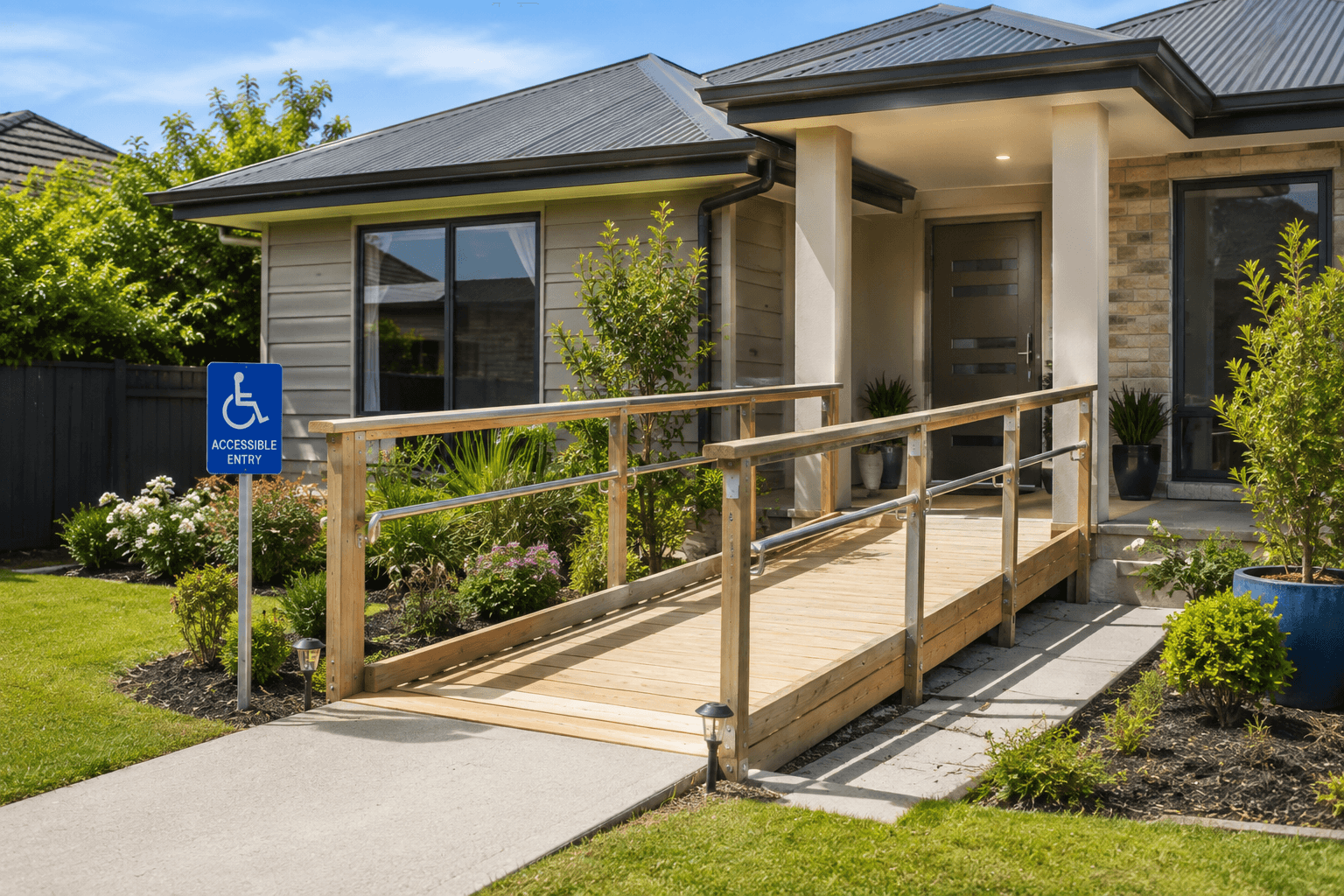
Entry modifications may include ramps, platform lifts, handrails, widened doors and weather-protected access.
Bathrooms and toilets
Modifications may include level-access showers, circulation space, suitable fixtures and safe transfer supports.
Internal access
Doorways, flooring, thresholds and room layouts may need adjustment to create continuous accessible routes.
Vehicle and parking access
Safe loading areas, covered access and sufficient space may be needed for wheelchair hoists or transfers.
Assessment delays
Long waits can leave people using unsafe temporary solutions or depending heavily on family members.
Future needs
Good planning should consider foreseeable changes instead of funding repeated alterations one problem at a time.
A modification must solve the whole access problem
Installing a ramp is not enough when the person still cannot reach the bathroom, turn inside rooms, access their vehicle or move safely through the property.
Choice, control and supported living
Disabled people should have meaningful choices about where they live, who they live with and what support they receive.
Living in an ordinary home
Disabled people should be supported to live in ordinary homes and neighbourhoods when that is their preference.
Choosing housemates
A person should not be forced to live with strangers merely because they require funded disability support.
Support separate from tenancy
Where practical, changing a support provider should not automatically place someone’s home at risk.
Location and community
Housing should allow people to remain connected with whānau, friends, culture, employment and familiar services.
Planning before crisis
Families need supported-living options before ageing carers or unstable arrangements reach breaking point.
Supported decision-making
Disabled people should receive accessible information and support to participate in major housing decisions.
Accessible public transport
Accessible vehicles are only one part of an accessible journey. Disabled passengers also need safe routes to stops, accessible information, reliable boarding equipment and trained staff.
Accessible bus stops
Stops need firm boarding areas, safe kerb access, sufficient space, shelter and connections with accessible footpaths.
Working ramps and lifts
Boarding equipment must be maintained, tested and available whenever an accessible service is advertised.
Wheelchair spaces
Mobility-device spaces should be usable, correctly designed and not treated as general storage.
Driver training
Drivers need practical disability training covering ramps, securement, communication, dignity and assistance.
Accessible information
Timetables, announcements, disruption notices and booking systems should be available in accessible formats.
Reliable connections
A failed accessible connection can leave a disabled person stranded without a safe alternative.
Total Mobility and wheelchair-accessible taxis
Total Mobility helps eligible disabled people use subsidised taxis or other approved transport when ordinary public transport cannot meet their needs.
The service is delivered regionally, which can result in different providers, fare limits, availability and local conditions.
Eligibility
Eligibility generally relates to whether disability prevents a person from completing one or more stages of an ordinary public-transport journey safely and independently.
Subsidised fares
Eligible users receive assistance towards approved journeys, but the user may still need to pay a substantial portion of the total cost.
Wheelchair-hoist vehicles
Some passengers require hoist-equipped or otherwise accessible vehicles that can safely carry them in their wheelchair.
Advance booking
Limited accessible-vehicle availability can require long advance bookings and make urgent or spontaneous travel difficult.
Regional inequality
Rural and smaller communities may have few participating operators or no suitable accessible vehicle at certain times.
Affordability limits
Even a subsidised fare may be unaffordable when journeys are long, frequent or required for essential healthcare and employment.
Footpaths, kerb crossings and roadworks
Footpaths connect homes with transport, shops, employment, healthcare and community facilities. A short inaccessible section can make the entire route unusable.
Roadworks must maintain an accessible route
A sign telling pedestrians to use the other side of the road is not an adequate solution when there is no safe crossing, kerb ramp or continuous route for wheelchair and mobility-device users.
Accessible parking
Accessible parking must provide more than a shorter walking distance. Many disabled people need extra space for wheelchair transfers, ramps, hoists and support people.
Transfer and access aisles
Bays need sufficient side or rear space for wheelchair transfers, ramps and vehicle-hoist operation.
Level and firm surfaces
Steep slopes, gravel and uneven surfaces can prevent safe transfers and make wheelchair movement difficult.
Accessible route to the entrance
The bay must connect with a safe kerb ramp or level route rather than forcing users into vehicle traffic.
Clear signs and markings
Bays and access aisles should be clearly marked and easy to identify in different lighting and weather conditions.
Enforcement
Misuse should be addressed consistently so designated spaces remain available to permit holders.
Different vehicle configurations
Parking design must recognise side-entry and rear-entry wheelchair vehicles rather than assuming all users transfer through the driver’s door.
Public buildings, toilets and community facilities
A building may have an accessible entrance while important services, counters, meeting rooms, toilets or emergency exits remain inaccessible.
Entrances and doors
Entrances should be step-free, easy to identify and usable without excessive force or complicated assistance.
Reception and service counters
Counters should provide wheelchair access, seating, communication support and alternatives to standing in long queues.
Accessible toilets
Toilets need adequate circulation, correctly positioned fixtures, safe transfers and reliable availability.
Changing facilities
Some people require larger spaces, adult-sized changing tables and hoists that ordinary accessible toilets do not provide.
Communication accessibility
Services should provide accessible websites, documents, hearing access, NZSL and alternative communication options.
Emergency evacuation
Plans must include disabled visitors and staff rather than leaving them waiting without a safe, tested procedure.
Accessible parks, playgrounds and recreation
Recreation, play and community events are important to health, childhood development, friendship and family life.
Accessibility must include the path into the space, facilities, equipment and opportunities to participate—not merely an accessible parking bay near an otherwise unusable area.
Accessible routes
Firm paths should connect parking and surrounding streets with equipment, seating, toilets and activity areas.
Inclusive playground equipment
Playgrounds should include equipment that disabled children can actively use with siblings, friends and carers.
Accessible safety surfacing
Loose bark, sand or gravel can prevent wheelchair and mobility-device users from reaching play equipment.
Inclusive seating and tables
Seating areas should include wheelchair spaces, accessible tables and suitable positions for families to sit together.
Accessible events
Community events need accessible venues, parking, toilets, communication and safe viewing or participation areas.
Consultation with disabled people
Disabled users should help choose equipment, review plans and test whether completed facilities work in practice.
Rural and regional accessibility
Disabled people living outside major cities may experience longer travel distances, fewer accessible vehicles, limited public transport and reduced access to specialised services.
Limited public transport
Some communities have infrequent services or no suitable public transport, leaving people dependent on private vehicles, family or taxis.
Accessible taxi shortages
Wheelchair-hoist vehicles may be unavailable at night, weekends or at short notice.
Long healthcare journeys
Specialist appointments may require expensive and tiring travel to another town or region.
Fewer housing choices
Accessible public, community and rental housing may be particularly limited in small towns.
Digital access
Online services can reduce travel, but they must not replace face-to-face options or assume everyone has suitable technology and internet access.
Community-led solutions
Local transport partnerships and accessible community hubs may help, but they require stable funding and involvement from disabled residents.
The role of councils and central government
Accessibility involves housing, building standards, disability support, transport, roads, planning and local facilities. Responsibility is therefore spread across central government, councils, transport agencies and service providers.
Central government responsibilities
- National housing and building policy.
- Public and community housing investment.
- Disability equipment and home modifications.
- Transport funding and national schemes.
- Accessibility standards and legislation.
- National disability strategy and monitoring.
Local government responsibilities
- Footpaths, crossings and local roads.
- Public transport planning and delivery.
- Parks, playgrounds and recreation facilities.
- Council buildings, libraries and public toilets.
- Local planning, consenting and urban design.
- Consultation with disabled residents.
Questions disabled people can ask about housing or access
Written information, photographs and dates can help demonstrate whether an apparent accessibility feature works in real life.
Useful questions and information to record
- Can I reach the entrance using a continuous route?
- Are paths wide, firm and free from steps?
- Is there sufficient wheelchair turning space?
- Can I use the bathroom and toilet safely?
- Can my vehicle hoist or ramp operate safely?
- Is accessible parking connected to the entrance?
- Can I reach a suitable public-transport stop?
- Is boarding equipment reliable and available?
- Are transport bookings affordable and practical?
- Can I access counters, seating and service areas?
- Are emergency procedures accessible?
- Who is responsible for correcting the barrier?
- When was the issue first reported?
- What temporary access will be provided?
- When will permanent work be completed?
- Was the solution tested with disabled users?
Questions political parties should answer about accessibility
Disabled people need measurable commitments covering housing, transport, infrastructure and community participation.
Accessible housing supply
How many new accessible and adaptable homes will your party commit to delivering, and by what date?
Accessible social housing
How will your party ensure public and community housing is accurately recorded and matched to disabled applicants?
Private rental accessibility
What changes will your party make to help disabled tenants obtain suitable homes and reasonable modifications?
Home modifications
How will your party reduce delays and ensure modifications solve the complete access problem?
Supported living
How will your party increase genuine choice about where, how and with whom disabled people live?
Accessible public transport
What enforceable standards and funding will your party provide for accessible vehicles, stops, stations and travel information?
Total Mobility
Will your party increase subsidies, improve national consistency and address the shortage of accessible vehicles?
Rural and regional transport
How will your party improve accessible transport outside major cities?
Footpaths and crossings
What national expectations will ensure councils provide continuous accessible pedestrian routes?
Accessible public buildings
Will your party strengthen and enforce accessibility standards for new and existing public buildings?
Accessible toilets and changing facilities
What will your party do to increase the availability of suitable toilets and adult changing facilities?
Inclusive recreation
How will your party support accessible parks, playgrounds, sport and community recreation?
Local-government accountability
Will councils be required to adopt accessibility plans, collect access data and report measurable progress?
Accessibility legislation
Will your party support enforceable accessibility legislation with standards, monitoring and effective remedies?
Useful accessibility organisations and information
Policies, subsidies and services can change. Check current eligibility and guidance with the responsible organisation.
New Zealand Disability Strategy
Read the 2026–2030 strategy and its priority outcomes, including housing.
Read the Disability StrategyTotal Mobility Scheme
Official Ministry of Transport information about the national subsidised transport scheme.
Read about Total MobilityDisability Support Services
Information about equipment, housing modifications and environmental support.
Visit Disability Support ServicesKāinga Ora
Information about public housing, applications, tenancy and accessible housing-related services.
Visit Kāinga OraCCS Disability Action
Disability support, accessibility advocacy and the national Mobility Parking Permit Scheme.
Visit CCS Disability ActionAccess Matters Aotearoa
Advocacy for accessibility legislation and the removal of accessibility barriers.
Visit Access MattersAccessible Playgrounds NZ
Information and advocacy about accessible and inclusive playgrounds in New Zealand.
Visit Accessible Playgrounds NZInclusive Playground Equipment
Guidance about accessible playground design, surfacing, equipment, parking and inclusive community recreation.
Visit Inclusive Playground EquipmentShare an accessibility barrier or success
Your lived experience can help demonstrate what must change
Inclusive World NZ invites disabled people, carers, whānau, advocates and community organisations to share experiences involving housing, home modifications, public transport, footpaths, parking, public buildings and recreation.
Contributions may be published using a full name, first name, organisation name or anonymously.
Related disability election resources
This page forms part of Inclusive World NZ’s independent disability and Election 2026 project.
Accessibility must work from the front door to the destination
Housing, transport and public spaces determine participation
Disabled people need suitable homes, reliable transport, continuous accessible routes and public facilities that can be used safely and independently.
Share this page and ask every political party how it will make accessibility measurable, enforceable and consistent throughout Aotearoa New Zealand.
Page information reviewed against sources available in July 2026. Policies, subsidies and services may change.