Disabled Children and Inclusive Education
Disabled Children and Inclusive Education Issues in New Zealand
Explore the education issues affecting disabled children, parents and whānau, including learning support, ORS funding, teacher aides, school attendance, accessibility, transport, bullying and the right to participate fully at school.
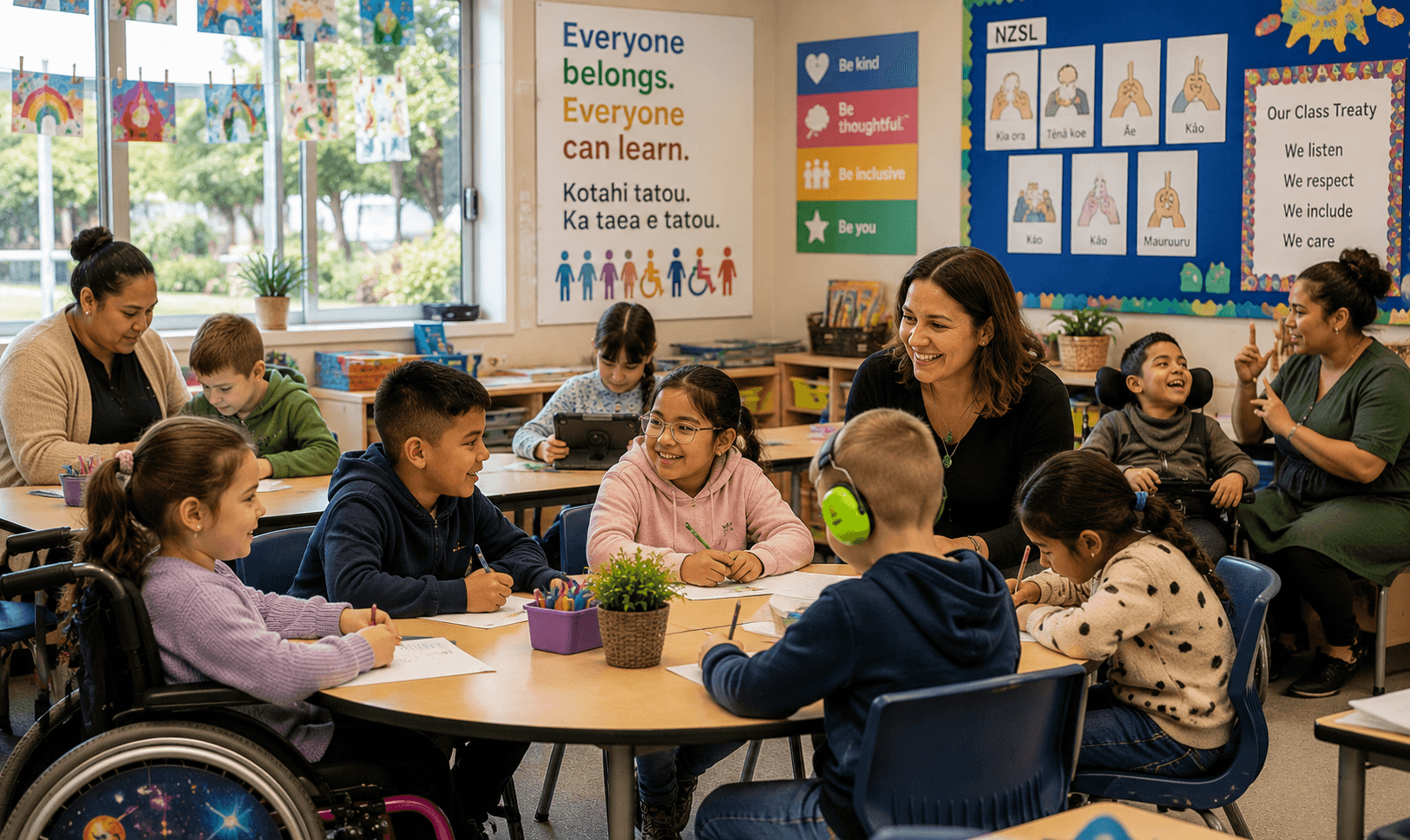
Every disabled child deserves to belong at school
Disabled children and young people have the same right to enrol, attend and participate in education as other students.
Inclusive education means more than allowing a disabled child to enter the school gate. It means providing the support, accessibility, teaching, communication and opportunities required for that child to learn and participate alongside their peers.
Families should not have to fight repeatedly for basic access, full-time attendance, suitable learning support or inclusion in school activities.
Education rights for disabled students in New Zealand
Disabled students and students with learning-support needs have the same legal rights to enrol and participate at state schools as students who do not have those needs.
Schools are responsible for planning how a student will be supported, including when a teacher aide or usual support person is absent.
The right to enrol
A school cannot refuse to enrol a child because of their disability, learning-support needs or need for additional assistance.
The right to attend full-time
An enrolled student has the right to attend during all the hours the school is open for instruction.
The right to participate
Disabled children should be included in classroom learning, sports, cultural activities, school trips, camps and other parts of school life.
The right to use support equipment
Students should have access to the mobility, communication and assistive devices they normally use.
Teacher-aide absence
A school should not send a child home or ask them to remain home because their teacher aide is absent.
Health and safety
Health and safety concerns should lead to proper planning and support rather than being used automatically to exclude a disabled student.
Informal exclusion is still exclusion
Families may be asked verbally to collect a child early, keep them home, accept shortened days or attend only when a particular staff member is available. Families should ask for the request, reasons and proposed plan in writing.
What inclusive education should look like
Inclusion is strongest when the school plans for diversity from the beginning rather than trying to fit a disabled student into an inflexible system.
A welcoming school culture
School leaders, staff and students should communicate that disabled children are valued members of the school community.
Accessible teaching
Lessons should offer different ways to receive information, communicate, participate and demonstrate learning.
Individual support planning
Plans should identify the student’s strengths, goals, communication, support needs and responsibilities of the school.
Belonging with peers
A child should not spend most of the school day isolated from classmates simply because additional support is required.
Accessible activities
Sports, arts, playground use, trips and camps should be planned so disabled students can participate safely and meaningfully.
Partnership with whānau
Parents and whānau should be treated as knowledgeable partners without being expected to provide unpaid staffing for the school.
Major inclusive education issues in Election 2026
Families throughout New Zealand may experience different versions of the same underlying barriers.
ORS funding and learning support
The Ongoing Resourcing Scheme, commonly known as ORS, provides a package of specialist support for students with the highest levels of ongoing need.
ORS is linked to the individual student and generally continues when that student changes schools until they leave the school system.
Who ORS is intended for
Eligibility focuses on severe and ongoing needs involving learning, hearing, vision, physical access, language use or social communication.
Specialist services
ORS may provide access to therapists, psychologists, learning-support advisers and other specialists.
Additional teacher time
The scheme can contribute additional staffing for specialist teaching and educational planning.
Teacher-aide contribution
ORS may include a contribution towards teacher-aide support, but it does not necessarily fund continuous one-to-one assistance.
Individual applications
An educator usually leads the application with input from parents, whānau, teachers, specialists and others who know the child well.
Children outside ORS
A child who does not meet ORS criteria may still have significant learning-support needs that the school and Ministry must consider through other support pathways.
Teacher aides and specialist learning support
Teacher aides can provide valuable assistance with communication, personal care, access, safety, learning activities and classroom participation.
They should support the student’s learning and independence rather than becoming the only person responsible for that student’s education.
Adequate support hours
Funded hours should reflect the child’s actual educational and participation needs, not only the minimum a school can manage.
Training and capability
Staff need suitable training in communication, mobility, personal care, sensory needs, behaviour and disability inclusion.
Continuity of support
Frequent changes in support staff can disrupt communication, trust, routines and learning.
Teacher responsibility
The classroom teacher remains responsible for teaching and including the student rather than delegating the whole relationship to a teacher aide.
Planning for absences
Schools should have backup plans so a student can continue attending when their usual support person is unavailable.
Access to specialists
Children may need timely support from therapists, psychologists, behaviour specialists, communication experts and Resource Teachers.
Reduced timetables and pressure to stay home
A genuinely temporary reduced-hours plan may occasionally be requested by a parent when it is in the child’s interests.
It should not become a convenient response to staff shortages, inaccessible environments, behavioural support needs or a lack of funding.
A legitimate temporary arrangement
- The parent or caregiver is involved and gives informed agreement.
- The reduced hours meet a genuine temporary need of the student.
- The arrangement has a written purpose and review date.
- A plan exists to restore or increase attendance.
- The student continues receiving appropriate education and support.
Warning signs of informal exclusion
- The school says it cannot manage the child for a full day.
- Attendance depends entirely on one teacher aide being present.
- Parents are repeatedly asked to collect the child early.
- There is no written plan or return-to-full-time date.
- The family is told reduced hours are the only option.
- The arrangement continues for months without meaningful review.
Ask for decisions in writing
When a school asks a child to remain home, leave early or attend reduced hours, families should ask who made the decision, the legal or policy basis, the support considered and the date the arrangement will be reviewed.
School attendance policies and disability
Regular attendance is important, but attendance problems cannot always be separated from disability, health, anxiety, inaccessible education or inadequate support.
Schools have been required to use Attendance Management Plans since Term 1 of 2026. Those plans should identify and address the causes of absence rather than treating every case as a parenting or motivation problem.
Health-related absence
Medical appointments, fatigue, chronic illness, pain and recovery may affect attendance.
School avoidance and anxiety
Anxiety may be connected with sensory overload, bullying, communication barriers or repeated negative experiences.
Unmet learning support
A child may struggle to attend when the school environment cannot meet their learning, communication or regulation needs.
Transport failures
Unreliable or unavailable suitable transport can prevent attendance even when a family wants the child at school.
Informal school requests
Attendance data may not show when a family has been asked by the school to keep a child home or collect them early.
A supportive response
Attendance planning should involve the child, family, school, specialists and relevant agencies working together.
Accessible schools and learning environments
Physical access is part of education. A child cannot participate equally when classrooms, toilets, paths, playgrounds, stages or school activities are inaccessible.
Assistive technology and accessible learning
Assistive technology may allow a disabled student to communicate, read, write, hear, see, move, organise information or complete learning activities more independently.
Communication systems
Students may use communication devices, symbol systems, communication boards, eye gaze or speech-generating tools.
Alternative access
Switches, adapted keyboards, specialist mice and touch or eye-control systems may improve computer access.
Reading and writing support
Text-to-speech, speech-to-text, audiobooks and accessible digital formats may reduce unnecessary barriers.
Vision and hearing access
Magnification, screen readers, captioning, listening systems and accessible documents may be required.
Staff training
Equipment has limited value when teachers and support staff do not know how to integrate it into everyday learning.
Assessment access
Students may need assistive technology or other approved conditions during formal assessments and examinations.
School transport for disabled students
Specialised School Transport Assistance may support eligible students whose mobility or safety needs prevent them from travelling independently to the nearest suitable state or state-integrated school.
Eligibility
Eligibility considers factors such as the student’s age, mobility, safety needs, school location and ability to travel independently.
Vehicle assistance
Some eligible students receive a place in a specialised school transport vehicle.
Travel contribution
In some circumstances, families may receive a contribution towards the cost of transporting the student.
Nearest suitable school
Eligibility may depend on attendance at the nearest school considered suitable for the student’s needs.
Wheelchair safety and access
Vehicles, restraints, loading systems and staff practices must safely accommodate mobility devices and individual needs.
Reliability
Late, cancelled or unsuitable transport can reduce attendance and place immediate pressure on working parents.
Bullying and social inclusion
Inclusion is not complete when a disabled child is physically present but isolated, mocked, ignored or excluded from friendships and activities.
Disability-based bullying
Schools should recognise bullying connected with disability, appearance, communication, behaviour or assistive equipment.
Communication barriers
Children who communicate differently may find it harder to report bullying or explain what occurred.
Peer understanding
Disability awareness and inclusive teaching can help build respect without singling out or embarrassing a student.
Friendship and participation
Schools should actively support opportunities for shared learning, play, leadership and friendship.
Safe reporting
Reporting processes should be accessible and should not rely solely on complex written or spoken communication.
Responding to harm
Schools should act promptly, communicate with families and monitor whether the response has restored safety.
The impact on parents, carers and whānau
When education support fails, responsibility is often transferred back to parents and carers.
Reduced employment
Parents may reduce work hours or leave employment when their child cannot attend school reliably or full-time.
Constant availability
Families may feel they must remain available throughout the school day in case the child needs to be collected.
Administrative burden
Meetings, applications, reports, complaints and repeated explanations require significant unpaid time.
Home learning pressure
Families may be expected to compensate for education missed because appropriate school support was unavailable.
Emotional strain
Repeated conflict over basic inclusion can affect parents, siblings and the disabled child.
Unequal opportunity
Families with money, professional knowledge or strong communication skills may be better able to challenge the system than others.
Transitions between education stages
Transitions should be planned early so important knowledge, equipment and support do not disappear when a child changes teacher, school or education level.
Questions families can ask schools
Written answers and agreed review dates can reduce confusion and help everyone understand their responsibilities.
Useful questions for meetings and support plans
- Who is responsible for coordinating learning support?
- What support is currently funded and for how many hours?
- How will support be provided when a staff member is absent?
- How will the classroom teacher include my child?
- What communication method will staff use?
- How will personal-care needs be managed respectfully?
- Which areas of the school are inaccessible?
- How will school trips and camps be made accessible?
- What is the plan for bullying or social isolation?
- How will progress be measured and reported?
- When will the support plan be reviewed?
- How will my child participate in decisions?
- What specialist services have been requested?
- What happens while the school waits for extra support?
- How are attendance and disability needs connected?
- What is the complaints and escalation process?
Questions political parties should answer about education
Disabled children and their families need clear commitments backed by funding, workforce planning and measurable outcomes.
Full-time education rights
How will your party stop disabled students being placed on reduced timetables or informally excluded because schools lack support?
Learning-support funding
How will your party ensure learning-support funding keeps pace with the number and needs of disabled students?
ORS eligibility and adequacy
Will your party review ORS eligibility, application processes and whether current support packages are adequate?
Teacher aides
How will your party improve teacher-aide availability, training, pay, continuity and funded support hours?
Specialist workforce
What will your party do about shortages and waiting times for therapists, psychologists and learning-support specialists?
Attendance and disability
How will your party ensure attendance policies identify inaccessible education and unmet disability support rather than unfairly blaming families?
Accessible school property
What funding and enforceable standards will your party provide for accessible classrooms, toilets, paths, playgrounds and shared facilities?
Assistive technology
How will your party reduce delays and improve training, maintenance and continuity of assistive technology?
School transport
How will your party improve eligibility, reliability, safety and national consistency for specialised school transport?
Bullying and inclusion
What action will your party take to reduce disability-based bullying, isolation and exclusion from school activities?
Support for parents and whānau
How will your party reduce the unpaid work and employment loss experienced by families when education support fails?
Transition to adulthood
How will your party improve planning for tertiary education, employment, adult disability support and community life?
Where families can seek help
The appropriate pathway may depend on whether the problem concerns enrolment, attendance, discrimination, learning support, transport, school conduct or a formal school decision.
Ministry of Education
Official information about enrolment rights, learning support, attendance, ORS, assistive technology and school transport.
Visit the Ministry of EducationSchool enrolment rights
Read official guidance about disabled students’ rights to enrol, attend full-time and participate in school.
Read enrolment-rights guidanceOngoing Resourcing Scheme
Official information about ORS eligibility, applications and the support that may be provided.
Read about ORSSpecialised School Transport
Official information about SESTA eligibility, vehicle assistance and travel contributions.
Read SESTA informationInclusive Education
New Zealand resources and guidance for supporting diverse learners and building inclusive school environments.
Visit Inclusive EducationOffice of the Ombudsman
Information about complaints concerning decisions and administration by public-sector organisations, including state schools in relevant circumstances.
Visit the OmbudsmanHuman Rights Commission
Information and support concerning discrimination and human rights in education and public life.
Visit the Human Rights CommissionParent to Parent
Information and peer support for parents and whānau of disabled children and people with health conditions.
Visit Parent to ParentKeep written records
Save emails, meeting notes, attendance information, support plans, assessments, reports and written decisions. Ask the school to confirm important verbal requests or agreements in writing.
Share your family’s inclusive education experience
Your story can show what is happening in real schools
Inclusive World NZ invites disabled students, parents, carers, whānau, educators and advocates to share experiences involving enrolment, ORS, teacher aides, attendance, accessibility, transport, bullying and school participation.
Contributions may be published using a full name, first name, organisation name or anonymously.
Related disability election resources
This page forms part of Inclusive World NZ’s independent disability and Election 2026 project.
Inclusive education should not depend on a family’s ability to fight
Rights must be supported by funding, accessibility and action
Disabled children need properly supported teachers, accessible schools, reliable transport, suitable technology and the opportunity to learn and belong alongside their peers.
Share this page and ask every political party how it will turn the legal right to education into a reliable everyday reality.
Page information reviewed against sources available in July 2026. Education policies and support arrangements may change.
Child Poverty and Disability
Families raising disabled children often face higher everyday costs, reduced earning opportunities and greater financial pressure. Learn more about the connection between child poverty, disability and material hardship in New Zealand.
Read About Child Poverty and Disability