Carers and Whānau Issues
Carers and Whānau Disability Issues in New Zealand
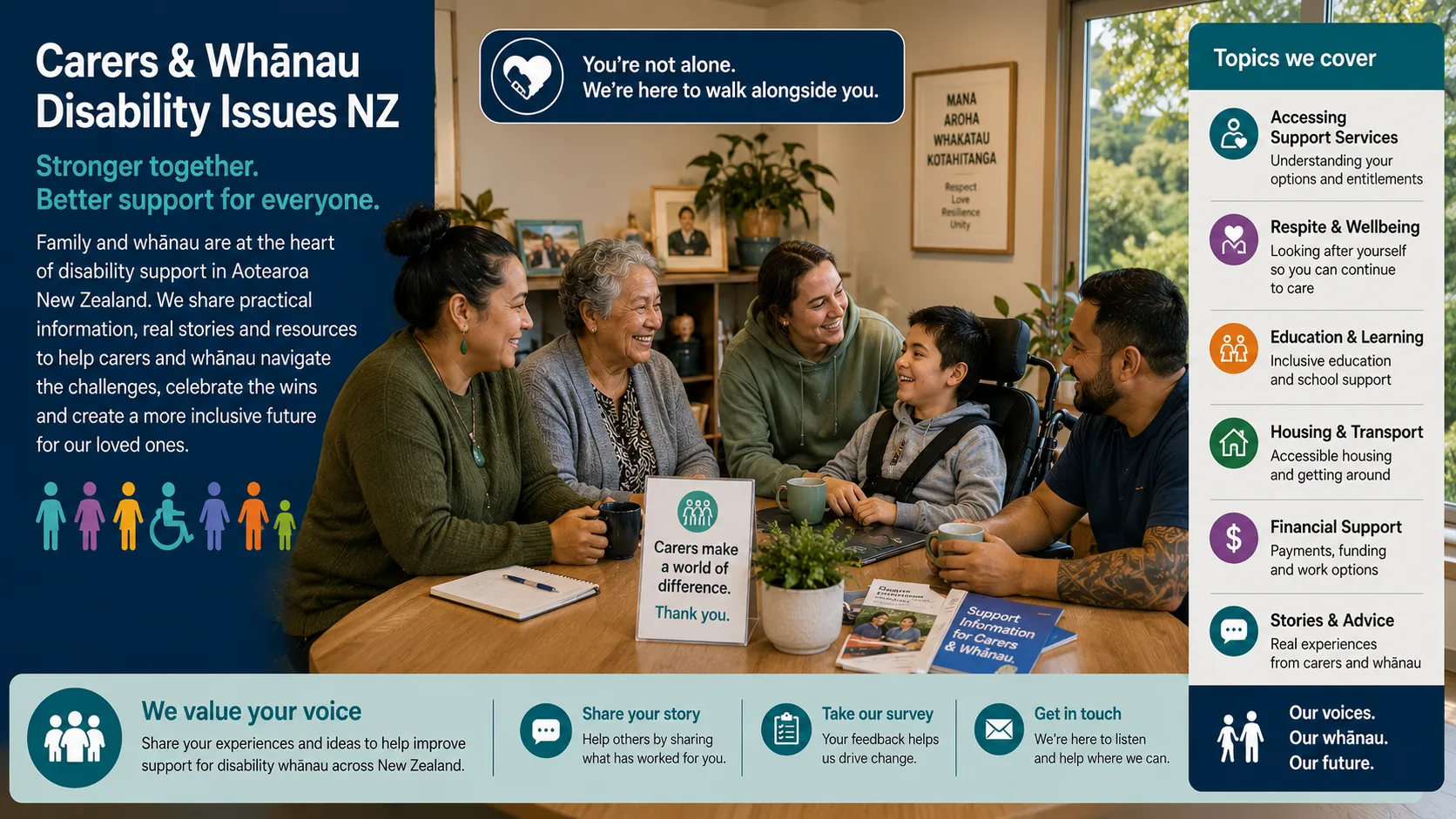
Explore the issues affecting unpaid carers, parent carers, families and whānau, including respite, Carer Support, paid family care, financial pressure, burnout and future planning.
Family carers are central to New Zealand’s disability system
Across Aotearoa New Zealand, parents, partners, siblings, relatives and whānau provide essential daily support to disabled people.
This support may include personal care, communication, medication, transport, supervision, emotional support, appointments, household tasks, advocacy, administration and responding to emergencies.
Much of this work is unpaid or only partly funded. It can affect a carer’s employment, income, health, sleep, relationships and ability to plan for their own future.
What is a family or unpaid carer?
A carer is someone who regularly supports another person because of disability, illness, injury, age or ongoing health needs.
Some carers identify strongly with the term. Others see themselves primarily as a parent, partner, sibling, child, friend or whānau member.
Parent carers
Parents may provide lifelong support involving personal care, education, healthcare, behaviour, communication and service coordination.
Partners and spouses
A partner may provide extensive physical, emotional and practical support while also maintaining the couple’s relationship and household.
Siblings and adult children
Siblings and adult children may gradually assume greater caring responsibilities as parents age or circumstances change.
Whānau carers
Caring may be shared across wider whānau, reflecting cultural, family and community relationships.
Young carers
Children and young people may provide practical or emotional support that affects their education, friendships and wellbeing.
Friend and community carers
Trusted friends or community members may provide regular assistance when family support is unavailable or limited.
Major disability issues affecting carers and whānau
Caring situations differ, but many families experience similar pressures within disability, health, education and income support systems.
Carer Support and respite in New Zealand
Carer Support is intended to help provide respite or a wellbeing break for a full-time unpaid carer.
Access and allocation are generally connected to a disability needs assessment. From 1 April 2026, Carer Support became part of the revised flexible-funding purchasing arrangements.
Respite that works in real life
A useful break should match the disabled person’s needs, routines, communication and safety requirements while providing genuine relief for the carer.
Flexible wellbeing options
The current policy may allow a broader range of suitable respite and wellbeing options when they align with the disabled person’s needs and plan.
Prior approval
Some purchases require approval from the relevant NASC or Enabling Good Lives site before money is spent or a claim is submitted.
Allocated budgets
Greater purchasing flexibility does not necessarily increase the amount of funding a person or family receives.
Availability of suitable support
A respite allocation may be difficult to use when there are workforce shortages or no provider able to meet the disabled person’s needs.
Carer wellbeing
Respite should be planned before a family reaches crisis, rather than offered only after exhaustion or breakdown.
Funding on paper is not always usable support
Carers may hold an approved allocation but still be unable to find a suitable worker, provider, activity or safe respite arrangement. The effectiveness of Carer Support should be measured by whether families can actually use it.
Paid family care and employment rights
Some disabled people employ a family or whānau member to provide funded support. This may be the most practical, culturally appropriate or trusted arrangement available.
Paid family care can sit alongside many additional unpaid hours, informal responsibilities and emergency support that are not covered by the funded allocation.
Official position and system purpose
- Funded family care can allow a disabled person to choose a trusted family member as a support worker.
- Employment arrangements should identify who the legal employer is and what hours are funded.
- The Disability Support Services Bill seeks to clarify the Crown’s position in relation to family-care employment.
- Government policy aims to define funded support and administrative responsibility more clearly.
Questions and community concerns
- Who is responsible when a family member provides far more care than the funded allocation recognises?
- Can family carers realistically refuse essential care when no alternative support is available?
- Are family carers receiving fair pay, leave, training and employment protections?
- Could legislation make it harder to challenge inadequate support or unpaid caring expectations?
- Are disabled people being offered genuine alternatives to relying on relatives?
The financial cost of unpaid disability care
Caring responsibilities can reduce a person’s ability to work, study, save for retirement or maintain long-term financial security.
Reduced working hours
Carers may work fewer hours or accept less demanding roles so they can remain available for appointments, emergencies and daily support.
Leaving employment
Some people leave paid work because appropriate support, respite, transport or education services are unavailable.
Additional household costs
Disability-related transport, electricity, food, equipment, clothing and housing costs can place extra pressure on the whole household.
Reduced retirement savings
Years outside employment may reduce KiwiSaver contributions, savings, career development and future financial security.
Administrative work
Applications, assessments, invoices, claims, appeals and service coordination require significant unpaid time.
Cost of unavailable services
Families may privately purchase support when funded services are delayed, unsuitable or unavailable.
Carer health, exhaustion and burnout
Long-term caring can involve physical lifting, interrupted sleep, emotional stress, constant supervision and responsibility for another person’s safety.
Carer health should not be treated as separate from the disabled person’s support plan. When a carer becomes unwell or exhausted, the entire support arrangement may become unsafe.
Sleep deprivation
Overnight supervision, personal care, seizures, distress or disrupted routines can prevent carers from receiving adequate sleep.
Physical injuries
Repeated lifting, transferring and physical assistance can cause back, shoulder and joint injuries.
Emotional pressure
Carers may experience anxiety about safety, future support, finances and what will happen if they become unavailable.
Social isolation
Limited replacement care can make it difficult to maintain friendships, community involvement or time outside the home.
Delayed healthcare
Carers may postpone their own appointments or treatment because nobody else is available to provide support.
Crisis and breakdown
Support systems should intervene before a household reaches a crisis that could have been prevented with appropriate respite and assistance.
Parent carers of disabled children
Parents of disabled children may need to coordinate education, healthcare, disability services, communication support, transport and advocacy across several government systems.
Early support
Families need timely assessments, therapy, equipment and practical information rather than long periods of waiting.
Inclusive education
Parents should not have to fight repeatedly for their child to attend school safely and participate in education.
School-hour employment barriers
Reduced school attendance, exclusions or frequent calls home can make stable employment difficult for parents.
School holidays
Families may have limited access to suitable programmes, respite or activities during long school breaks.
Transition to adulthood
Families need early information about adult support, employment, housing, income and community participation.
Whole-family wellbeing
Support should recognise parents, siblings and the wider family rather than viewing the disabled child in isolation.
Ageing carers and future planning
Many parents and relatives continue providing substantial care as they themselves grow older or develop health and mobility limitations.
Families should not be expected to wait until a carer dies, becomes seriously ill or can no longer cope before long-term support is planned.
When disability systems assume families will provide care
Assessments may consider support available from family and whānau. However, the existence of a relative does not automatically mean that person is willing, able, available or safe to provide unlimited unpaid care.
Employment responsibilities
A family member may have employment, study or business commitments that limit their availability.
Health and disability
Carers may have their own disability, illness, pain, mobility limitations or mental-health needs.
Other family responsibilities
A carer may also support children, older relatives or another disabled family member.
Relationship choice
Disabled adults and relatives should be able to maintain family relationships that are not defined entirely by care.
Safety and skill
Some care requires training, equipment or physical capacity that a relative may not safely possess.
Sustainability
Support that can be maintained briefly during an emergency may not be sustainable every day for many years.
Family availability should never be assumed without consent
Assessments should record what each person is genuinely able and willing to provide. They should also recognise the risks created when an unpaid caring arrangement is already exhausted or unstable.
Tāngata whaikaha Māori and whānau support
Disability support should recognise the identity, culture, relationships and collective responsibilities of tāngata whaikaha Māori and their whānau.
Whānau involvement can be a source of strength. It should not be used to justify inadequate government support or transfer unsustainable responsibility onto families.
Whānau-led planning
Planning should include the disabled person and the whānau members they choose, using an accessible and respectful process.
Culturally appropriate support
Services should respect tikanga, whakapapa, language, identity and connections with whānau and community.
Equitable access
Location, transport, cost and workforce availability should not create greater barriers for Māori communities.
Te Tiriti participation
Tāngata whaikaha Māori should participate meaningfully in disability policy, governance and service design.
Recognition without exploitation
Valuing whānau support must include proper resources rather than assuming whānau will fill every service gap.
Intergenerational wellbeing
Disability policies should consider their effects across children, parents, grandparents, siblings and future generations.
What carers and whānau should record
Assessors may not understand the full amount of support being provided unless the family explains it clearly.
Information that may help describe the caring situation
- Personal-care tasks provided each day
- Night-time support and interrupted sleep
- Supervision needed for safety
- Medication and healthcare responsibilities
- Transport and appointment time
- Communication and behavioural support
- Hours of paid support currently available
- Additional unpaid support hours
- Carer health conditions or injuries
- Employment or study affected by caring
- Other children or relatives requiring support
- Respite allocations that cannot be used
- Recent changes in household circumstances
- Risks if the main carer becomes unavailable
- Support required to prevent crisis
- Future housing and support concerns
Questions political parties should answer about carers
General expressions of appreciation are not enough. Carers and whānau need practical commitments, funding and measurable change.
Carer recognition
How will your party formally recognise the economic and social contribution made by unpaid family and whānau carers?
Respite and Carer Support
How will your party ensure carers receive adequate, flexible and genuinely usable respite support?
Financial security
What will your party do to address lost income, reduced employment and retirement disadvantage caused by long-term caring?
Paid family care
How will your party protect fair employment arrangements and rights for family members who provide funded disability support?
Unpaid care beyond allocations
How will your party prevent families being forced to provide essential unpaid care because funded support is inadequate or unavailable?
Parent carers
What additional support will your party provide to parents of disabled children, including education, respite and transition to adulthood?
Ageing carers
How will your party ensure long-term housing and support are planned before an ageing carer reaches crisis?
Carer health
How will your party improve access to healthcare, mental health support and preventive assistance for carers?
Emergency support
What support will be available when a primary carer suddenly becomes ill, injured or unavailable?
Whānau and Te Tiriti
How will your party support tāngata whaikaha Māori and whānau without relying on unpaid whānau care to fill service gaps?
Useful organisations and carer information
Support options depend on personal circumstances and location. Check current eligibility, guidance and contact details with the relevant organisation.
Disability Support Services
Official information about Carer Support, assessments, flexible funding and support for family carers.
Visit DSS information for carersHow to access Carer Support
Official information about assessments, allocation and the Carer Support purchasing policy.
Read Carer Support guidanceCarers New Zealand
Information, resources and advocacy for family, whānau and aiga carers throughout New Zealand.
Visit Carers New ZealandCCS Disability Action
Disability support, respite information, advocacy and commentary on issues affecting disabled people and families.
Visit CCS Disability ActionParent to Parent
Information and peer support for parents and whānau of disabled children and people with health conditions.
Visit Parent to ParentDisability Connect
Disability information, advice, seminars, support groups and community conversations.
Visit Disability ConnectDisabled Persons Assembly NZ
Disability-rights advocacy and information from a national disabled people’s organisation.
Visit Disabled Persons Assembly NZOur Community Speaks
Read opinions and lived experiences from carers, disabled people, advocates and disability organisations.
Read community opinionsShare your experience as a carer or family member
Your contribution can make hidden work visible
Inclusive World NZ invites carers, parents, siblings, partners and whānau to share experiences involving respite, assessments, paid family care, financial pressure, burnout and future planning.
Contributions may be published using a full name, first name, organisation name or anonymously.
Related disability election resources
This page forms part of Inclusive World NZ’s independent disability and 2026 election project.
Carers and whānau deserve more than appreciation
Recognition must be supported by practical action
Families need adequate disability services, usable respite, financial security, fair employment arrangements and confidence that support will remain available in the future.
Share this page and ask every political party how it will support carers, protect disabled people’s rights and prevent families from carrying unsustainable responsibilities.
Page information reviewed against sources available in July 2026. Policies and support arrangements may change.
Child Poverty and Disability
Families raising disabled children often face higher everyday costs, reduced earning opportunities and greater financial pressure. Learn more about the connection between child poverty, disability and material hardship in New Zealand.
Read About Child Poverty and Disability