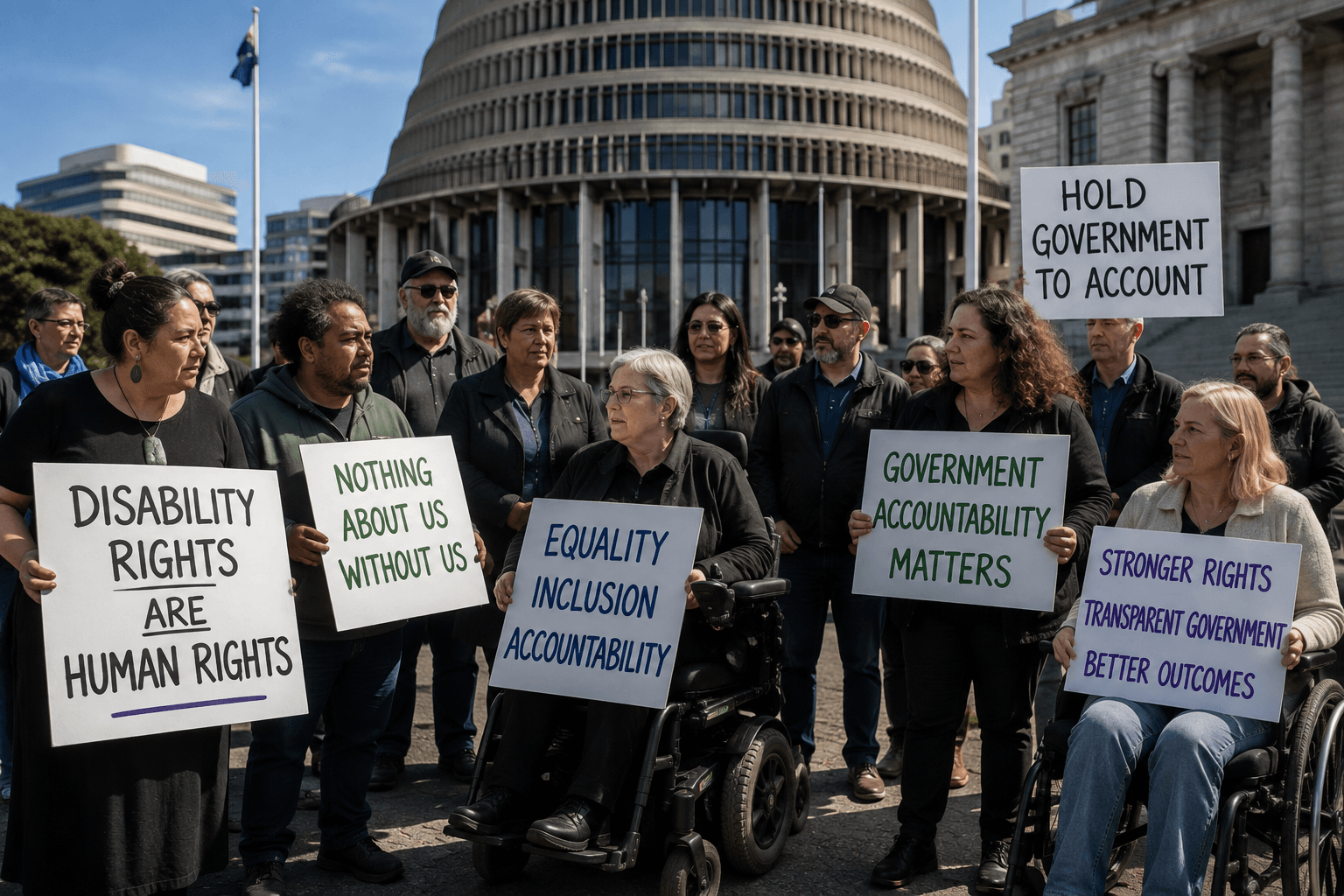
Disability Rights and Government Accountability
Disability Rights and Government Accountability in New Zealand
Understand disability rights, the UN Disability Convention, government consultation, reasonable accommodation, discrimination, complaints, transparency and the questions political parties should answer before Election 2026.
Disability rights are human rights
Disabled people are entitled to the same human rights, freedoms, dignity and opportunities as other people.
Disability rights are not limited to disability services. They include education, housing, healthcare, employment, transport, family life, accessibility, political participation, communication, justice and the right to live in the community.
Governments must do more than avoid deliberate discrimination. They must also identify and remove barriers that prevent disabled people from participating equally.
Important disability rights in New Zealand
Human rights are connected. A barrier in one area can prevent a disabled person from exercising several other rights.
The UN Convention on the Rights of Persons with Disabilities
New Zealand ratified the United Nations Convention on the Rights of Persons with Disabilities, often shortened to the UNCRPD or Disability Convention, on 25 September 2008.
The Convention does not create a separate category of special rights. It explains how existing human rights must be protected and realised for disabled people.
Respect for dignity
Disabled people must be treated as individuals with equal worth, autonomy and the right to make choices.
Non-discrimination
Laws, policies and services should not unfairly exclude or disadvantage people because of disability.
Full participation
Disabled people have the right to participate fully and effectively in society and community life.
Respect for difference
Disability is part of human diversity and should not be treated as a reason for exclusion or reduced rights.
Equality of opportunity
Public systems should remove barriers and create fair opportunities rather than assuming identical treatment is always equal treatment.
Accessibility
Governments must work to make physical environments, transport, information, communication and services accessible.
Gender equality
Disabled women and girls must enjoy rights and freedoms on an equal basis and be protected from multiple forms of discrimination.
Rights of disabled children
Disabled children must have equal rights, and their views should be considered according to their age and maturity.
Government reporting
New Zealand must report internationally on the steps it is taking and the progress made towards implementing the Convention.
The New Zealand Disability Strategy 2026–2030
The New Zealand Disability Strategy gives direction to government agencies on issues disabled people, tāngata whaikaha Māori and whānau have identified as important.
A strategy can guide action, but its value depends on clear responsibility, adequate funding, public reporting and whether promised actions lead to real improvements.
Education
Disabled children and adults should have equitable access to inclusive education, learning and skills development.
Employment
Disabled people should have fair opportunities to obtain, retain and progress in suitable employment.
Health
Healthcare should be accessible, timely and responsive to disability-related inequities.
Housing
Disabled people need affordable, accessible homes and real choice about where and with whom they live.
Justice
Disabled people should be able to understand, access and participate in the justice system.
Measuring progress
Outcomes should be monitored using transparent indicators, public data and evidence from disabled people.
A strategy is not enforceable protection by itself
A government strategy may set direction without giving an individual a direct legal remedy when a public agency fails to deliver. Political parties should explain how strategy promises will be funded, measured and enforced.
Nothing about us without us
“Nothing about us without us” expresses the principle that disabled people must participate meaningfully in decisions that affect their rights, services and lives.
Participation must happen before major decisions are finalised. Asking for feedback after the policy direction, funding and implementation plan have already been decided is not genuine co-design.
Early involvement
Disabled people should help identify the problem, establish priorities and design the process from the beginning.
Accessible participation
Information and meetings should be available in formats including Easy Read, NZSL, audio, Braille, large print and accessible digital documents.
Enough time
Consultation periods should allow people and organisations enough time to understand proposals, seek support and prepare responses.
Payment for expertise
Disabled people should not always be expected to provide professional knowledge, lived experience and policy advice without payment.
Diverse representation
Participation should include different impairment groups, ages, cultures, regions, communication methods and life experiences.
Visible influence
Agencies should report what they heard, what changed because of the feedback and why some recommendations were not accepted.
Consultation, co-design and disabled leadership
Consultation and co-design are not the same. Both can be useful, but agencies should describe honestly how much power disabled participants have within the process.
Basic consultation may involve
- Publishing a draft proposal.
- Inviting written submissions.
- Holding public or online meetings.
- Collecting survey responses.
- Considering feedback before the final decision.
- Publishing a summary of submissions.
Genuine co-design should involve
- Shared influence over goals and priorities.
- Disabled people involved from the beginning.
- Accessible and properly resourced participation.
- Recognition and payment for expertise.
- Transparent decision-making power.
- Ongoing involvement in implementation and review.
Representation must not become tokenism
Inviting one disabled person to a meeting does not mean the disability community has been represented. The person must have accessible information, enough time, meaningful influence and support to participate.
Reasonable accommodation
Reasonable accommodation means making necessary and appropriate changes so a disabled person can exercise rights and participate equally.
The correct adjustment depends on the person, environment and barrier. It should be discussed with the disabled person rather than based only on assumptions.
Accessible communication
Providing NZSL, Easy Read, captioning, communication support or information in another suitable format.
Workplace adjustments
Adjusting hours, equipment, duties, communication, recruitment or the physical workplace.
Education support
Providing accessible materials, assistive technology, learning support or alternative assessment arrangements.
Service access
Allowing additional time, support people, alternative appointments or accessible ways to complete a process.
Physical access
Changing meeting locations, routes, seating or facilities so the disabled person can enter and participate safely.
Individual discussion
The organisation should talk with the person about what is needed rather than applying a one-size-fits-all response.
Disability discrimination in New Zealand
Disability discrimination may be direct and obvious, or it may result from a rule, process or environment that appears neutral but places disabled people at a substantial disadvantage.
Direct discrimination
Treating someone less favourably specifically because they are disabled or are assumed to be disabled.
Inaccessible processes
Requiring everyone to use a communication, application or meeting process that some disabled people cannot access.
Failure to accommodate
Refusing to consider a reasonable change that would allow a disabled person to participate.
Disability harassment
Humiliating, threatening or degrading behaviour related to disability, impairment or the use of support equipment.
Systemic discrimination
Policies or institutional practices that repeatedly produce unequal outcomes for disabled people.
Multiple discrimination
A person may experience connected barriers involving disability, race, gender, age, family status or another protected characteristic.
Why accessibility legislation matters
New Zealand has accessibility requirements spread across different laws, standards, policies and public agencies.
Disability advocates have long argued that clearer and stronger legislation is needed to identify barriers, set standards, monitor compliance and provide effective remedies.
Clear accessibility standards
Organisations need understandable requirements covering areas such as buildings, transport, information, communication and public services.
Defined responsibilities
Legislation should identify which public bodies, businesses and service providers are responsible for removing barriers.
Implementation timeframes
Plans should include measurable deadlines rather than promises to improve accessibility at an unspecified future date.
Independent monitoring
Progress should be checked by bodies with suitable expertise and independence from the agencies being monitored.
Accessible complaints
Disabled people need simple and accessible ways to report barriers without carrying the entire enforcement burden.
Effective remedies
There should be practical consequences and corrective action when organisations fail to meet accessibility duties.
Government transparency and public information
Disabled people cannot assess government performance when decisions, evidence, budgets and implementation information are difficult to obtain or understand.
Written reasons
Public agencies should provide clear reasons for decisions, including the policy and evidence considered.
Accessible documents
Important policies, consultations and decisions should be available in accessible formats.
Budget transparency
Government announcements should explain whether funding is new, reprioritised, temporary or sufficient for expected demand.
Publication of evidence
Agencies should release the research, data and advice used to support major disability policy changes.
Official Information Act
People can request official information from government agencies, subject to lawful reasons for withholding some material.
Correction and review
Agencies should correct inaccurate information and explain how decisions can be reviewed or complained about.
Complaints, reviews and independent oversight
The correct pathway depends on the agency, decision and type of right involved. Formal deadlines may apply.
Request the decision
Ask for the decision, reasons, evidence, policy and review process in writing.
Use the agency process
Submit a review, reconsideration or complaint through the organisation responsible.
Seek advocacy
A disability advocate, community organisation or lawyer may help identify the appropriate pathway.
Consider external oversight
The Ombudsman, Human Rights Commission or another body may be relevant, depending on the issue.
Do not rely on a general complaint to protect a legal deadline
Some disputes require a particular review, appeal or legal claim within a specified time. Obtain individual advice when rights, income, housing, employment or essential support may be at risk.
The Ombudsman and government agencies
The Ombudsman can investigate complaints about administrative decisions and actions by many central and local government organisations.
The Ombudsman also has responsibilities connected with official information and monitoring fair treatment of disabled people.
Government decisions
The Ombudsman may examine whether a public agency acted fairly, reasonably and according to appropriate procedures.
Official information
Complaints may be made when an agency refuses, delays or inadequately responds to an official-information request.
Accessibility and fairness
The Ombudsman publishes information about reasonable accommodation and fair treatment of disabled people.
Independent Monitoring Mechanism
The Ombudsman participates in independent monitoring of New Zealand’s implementation of the Disability Convention.
Public-agency complaints first
People are generally encouraged to raise the issue directly with the organisation before asking the Ombudsman to investigate.
Not every dispute is covered
The Ombudsman cannot investigate every organisation or replace all court, tribunal or specialist appeal processes.
The Human Rights Commission and Human Rights Review Tribunal
The Human Rights Commission provides information and dispute resolution relating to unlawful discrimination.
The Human Rights Review Tribunal is separate from the Commission and hears claims under legislation including the Human Rights Act.
Human Rights Commission
A person who believes they have experienced unlawful discrimination can contact the Commission for information and may use its dispute-resolution process.
Disability as a protected ground
The Human Rights Act includes disability among the characteristics protected from discrimination in covered areas of public life.
Human Rights Review Tribunal
The Tribunal can hear eligible claims involving the Human Rights Act, privacy law and health and disability consumer rights.
Complaint required first
Before making a Human Rights Act claim to the Tribunal, the person must first make a complaint to the Human Rights Commission.
Evidence and records
Emails, documents, dates, witness information and written explanations may help demonstrate what occurred.
Legal advice
Tribunal proceedings can involve legal and procedural complexity. Individual advice may be important before filing a claim.
Tracking government promises and outcomes
Government accountability requires more than recording what was promised. The community must also be able to see what was funded, delivered and experienced by disabled people.
Information a disability promise tracker should record
- The original promise or policy commitment
- The party or agency responsible
- The date the commitment was made
- The people and services affected
- The amount and source of funding
- The planned implementation date
- The agency responsible for delivery
- The consultation or co-design process
- The accessibility of public information
- The indicators used to measure progress
- Reports from disabled people and organisations
- Delays, changes or reductions
- Whether the action was completed
- Whether outcomes improved in real life
- The date the information was last checked
- Links to original documents and evidence
Questions disabled people can ask public agencies
Clear written questions can help identify who made a decision, what evidence was used and how the decision can be challenged.
Useful questions about a public decision or policy
- Who made the decision?
- Under what law, policy or authority was it made?
- What information and evidence were considered?
- Were disabled people involved before the decision?
- How was tāngata whaikaha Māori participation supported?
- What accessibility impact assessment was completed?
- What alternative options were considered?
- How were human-rights obligations assessed?
- What funding has been allocated?
- When will the decision be implemented?
- How will outcomes be measured?
- When will the policy be reviewed?
- How can inaccurate information be corrected?
- What complaint or review process is available?
- Can the information be provided accessibly?
- Can supporting documents be requested officially?
Questions political parties should answer about disability rights
Political parties should explain how their commitments will strengthen rights, participation, transparency and effective remedies.
UNCRPD implementation
How will your party ensure New Zealand fully implements its obligations under the UN Convention on the Rights of Persons with Disabilities?
Accessibility legislation
Will your party support enforceable accessibility legislation, and what standards, monitoring and remedies will it include?
Nothing about us without us
How will your party ensure disabled people participate meaningfully before disability policies and budgets are decided?
Payment for lived expertise
Will disabled people and disability organisations be funded fairly for substantial consultation, governance and co-design work?
Tāngata whaikaha Māori
How will your party uphold Te Tiriti o Waitangi and support tāngata whaikaha Māori leadership in disability policy?
Reasonable accommodation
What action will your party take to improve understanding, delivery and enforcement of reasonable accommodation?
Discrimination complaints
How will your party make discrimination complaints faster, more accessible and less burdensome for disabled people?
Independent oversight
Will your party strengthen independent monitoring of disability rights and provide adequate resources for that work?
Government transparency
How will your party ensure disability policy advice, evidence, budgets and implementation reports are published accessibly?
Review and appeal rights
Will disabled people have clear, independent and enforceable review rights when essential support is refused or reduced?
Disability Strategy accountability
How will your party fund, measure and publicly report progress under the New Zealand Disability Strategy 2026–2030?
Cabinet and policy impact assessments
Will major government proposals be required to assess and publish their likely effects on disabled people?
Accessible democracy
How will your party improve accessible voting, political information and representation of disabled candidates?
Government accountability after the election
What independent mechanism will allow the disability community to track whether your election promises are kept?
Useful disability-rights organisations and official information
Rights and complaint pathways depend on the circumstances. Check current information and obtain individual advice where necessary.
UN Disability Convention
Ministry of Justice information about New Zealand’s ratification and reporting obligations.
Read about the Disability ConventionNew Zealand Disability Strategy
Read the 2026–2030 Strategy, accessible formats and delivery information.
Read the Disability StrategyOffice of the Ombudsman
Information about public-agency complaints, official information and fair treatment of disabled people.
Visit the OmbudsmanReasonable accommodation guide
Independent Monitoring Mechanism guidance about removing barriers and making reasonable changes.
Read the accommodation guideHuman Rights Commission
Information and dispute resolution involving discrimination and human rights.
Visit the Human Rights CommissionHuman Rights Review Tribunal
Information about eligible claims, filing requirements and Tribunal processes.
Visit the Tribunal informationDisabled Persons Assembly NZ
A national disabled people’s organisation involved in disability-rights advocacy and public-policy submissions.
Visit Disabled Persons Assembly NZAccess Matters Aotearoa
Advocacy for accessibility legislation and systematic removal of accessibility barriers.
Visit Access MattersShare a disability rights or accountability experience
Your experience can reveal where systems are failing
Inclusive World NZ invites disabled people, carers, whānau, advocates and organisations to share experiences involving discrimination, consultation, inaccessible services, government decisions, complaints or reasonable accommodation.
Contributions may be published using a full name, first name, organisation name or anonymously.
Related disability election resources
This page forms part of Inclusive World NZ’s independent disability and Election 2026 project.
Rights without accountability can become promises without change
Disabled people need participation, transparency and effective remedies
Governments must explain their decisions, involve disabled people meaningfully, publish evidence and provide accessible ways to challenge unfair treatment.
Share this page and ask every political party how it will turn disability-rights commitments into enforceable and measurable improvements.
Page information reviewed against sources available in July 2026. Laws, policies and complaint processes may change.