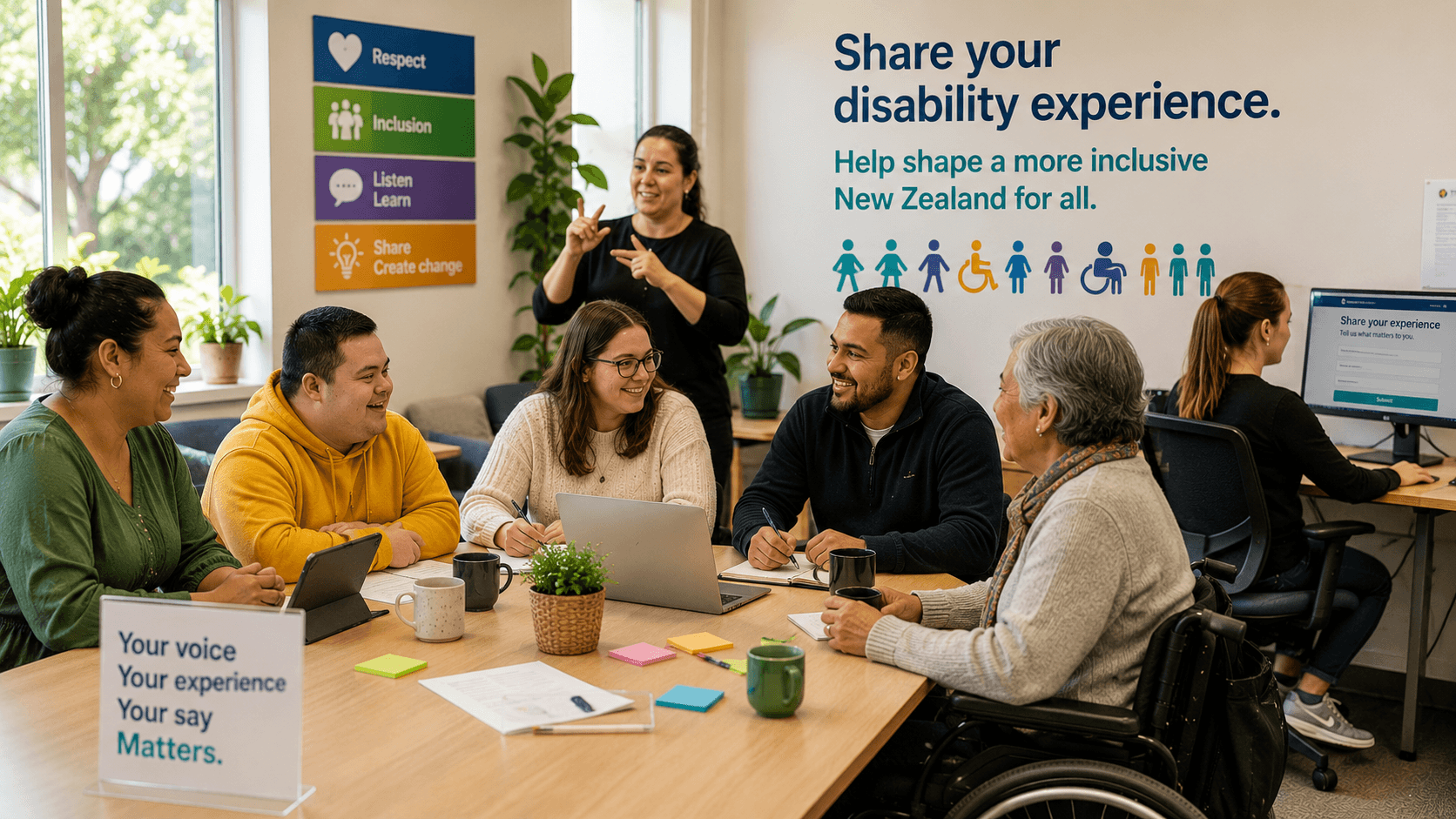
Share Your Disability Experience
Share Your Disability Experience
Disabled people, carers, parents, whānau, advocates and disability organisations are invited to share their experiences, concerns, opinions and ideas with Inclusive World NZ.
Help the disability community be heard
Government decisions, disability services and public policies can have major effects on people’s independence, safety, wellbeing and ability to participate in their communities.
Official reports and political announcements do not always show what these decisions mean in everyday life. Personal experiences can help the wider public and decision-makers understand the barriers disabled people, carers and whānau are facing.
Your contribution may be published in the Inclusive World NZ community-opinions section as part of our growing disability and 2026 election resource.
Who can share an experience or opinion?
We welcome a wide range of disability-community perspectives. Contributors may write as individuals or on behalf of an organisation.
Disabled people
Share your direct experience of disability support, accessibility, discrimination, inclusion, healthcare, employment or community life.
Tāngata whaikaha Māori
Share perspectives involving disability, whānau, culture, equity, Te Tiriti, public services and participation in decision-making.
Carers and whānau
Discuss caring responsibilities, respite, financial pressure, family wellbeing and experiences of navigating disability systems.
Parents of disabled children
Share experiences involving education, healthcare, assessments, inclusion, family support and planning for your child’s future.
Advocates and organisations
Submit advocacy perspectives, policy concerns, public statements, research findings or practical recommendations.
Allies and professionals
Share informed observations while respecting the privacy, dignity and voices of disabled people.
You do not need to send a finished article
Communication and writing can create barriers. We therefore welcome contributions in several formats.
A completed article
Send a finished opinion article or personal account that is ready to be reviewed for publication.
A short experience
Send a few paragraphs explaining what happened, how it affected you and what should change.
Rough notes
Send bullet points or unedited notes. We may help organise them into a readable contribution.
A dictated contribution
People who find typing difficult may ask about submitting spoken, dictated or transcribed information.
What can you write about?
Your contribution may focus on one issue or explain how several issues affect you, your family, your organisation or your community.
How to contribute to Our Community Speaks
We want the contribution process to be understandable and accessible.
Choose your subject
Decide which experience, policy, barrier or idea you want readers and decision-makers to understand.
Tell your story
Write an article, send a short account or provide notes explaining the issue in your own words.
Choose your identity
Tell us whether you want your full name, first name, organisation name or no public name displayed.
Review and publication
Suitable contributions will be reviewed and may be edited for clarity before publication.
Helpful information to include
You do not have to answer every point. Include the information that is relevant and comfortable for you to share.
Suggested submission details
- Your proposed title or main subject
- Your experience, concern or opinion
- How the issue affected you or your community
- What you believe should change
- Any solution or improvement you recommend
- Your town or region, when relevant
- Your organisation, when applicable
- Links to useful supporting information
- How you want your name displayed
- Permission to edit the contribution for clarity
- Permission to publish the contribution online
- Confirmation that the contribution is your own
Choose how you are identified
Contributors can choose the level of public identification that is appropriate for their circumstances.
Full name
Your full name appears with your contribution.
First name only
Only your first name is displayed publicly.
Organisation name
The contribution is published for an organisation.
Anonymous
Your name is not displayed on the public article.
Anonymous contributions
Anonymous publication can protect your public identity. However, people familiar with a situation may sometimes recognise details contained in a story.
Consider removing unnecessary names, locations, service details or other information that could identify you or another person.
Send your contribution to Inclusive World NZ
Start by contacting us
Use our contact page to introduce yourself and briefly explain the experience or opinion you would like to contribute.
You can tell us whether you have a finished article, a shorter personal account, rough notes or need help preparing your contribution.
Submission and publication guidelines
These guidelines protect contributors, readers and the credibility of the community resource.
- Submissions should relate to disability, caring, accessibility, public policy, inclusion or the 2026 election.
- Contributors should describe their experiences honestly and avoid deliberately misleading claims.
- Strong criticism of governments, political parties, public policies and organisations is permitted when expressed respectfully.
- Submissions must not contain threats, hate speech, discriminatory language or personal abuse.
- Serious allegations about identifiable people may require evidence and may be declined.
- Private information about another person should not be included without permission.
- Extra care must be taken when discussing children or vulnerable people.
- Contributions may be edited for spelling, structure, clarity, accessibility and reasonable length.
- Publication is not guaranteed, and unsuitable content may be declined or removed.
- The contributor remains responsible for the views expressed in their contribution.
Privacy, safety and sensitive information
A published webpage can be read, indexed by search engines and shared publicly. Contributors should think carefully about the personal details they include.
Before submitting personal information
Do not include home addresses, personal identification numbers, private financial details, confidential medical documents or other information that is not necessary to tell your story.
Avoid naming support workers, individual staff members, children or other private individuals unless there is a clear reason and appropriate permission has been obtained.
Inclusive World NZ may remove identifying details or ask for changes before publication.
Urgent personal problems and formal complaints
This community-opinions project is not an emergency service, legal service or formal complaints authority. Do not rely on a submission to obtain urgent assistance, protect a legal deadline or resolve an immediate safety concern.
How contributions may be edited
Some contributors may be confident writers. Others may use speech-to-text, communication support, artificial intelligence or assistance from another person. These methods should not prevent someone from being heard.
Clarity and structure
Paragraphs, headings and sentence structure may be improved to make a contribution easier to understand.
Spelling and grammar
Spelling, punctuation and grammar may be corrected without intentionally changing the contributor’s meaning.
Privacy and safety
Identifying, private or legally sensitive details may be removed or rewritten before publication.
Length and repetition
Longer contributions may be shortened while retaining the main experience, argument and recommended changes.
Author approval
Significant changes should be discussed with the contributor before the article is published.
Original meaning
Editing assistance should support the author’s voice rather than replacing it with someone else’s opinion.
Related disability community pages
This submission page is part of Inclusive World NZ’s growing disability and election resource.
Your experience could help someone understand
Help create a public record of disability experiences
Every contribution can help show what policies, services and accessibility barriers mean in the lives of real people.
Contact Inclusive World NZ to propose your contribution or ask about a more accessible way to share your experience.
All submissions are reviewed. Publication is not guaranteed.